I just can't imagine not seeing this!
Since 1948 Berganz Austria on Lake Constance:
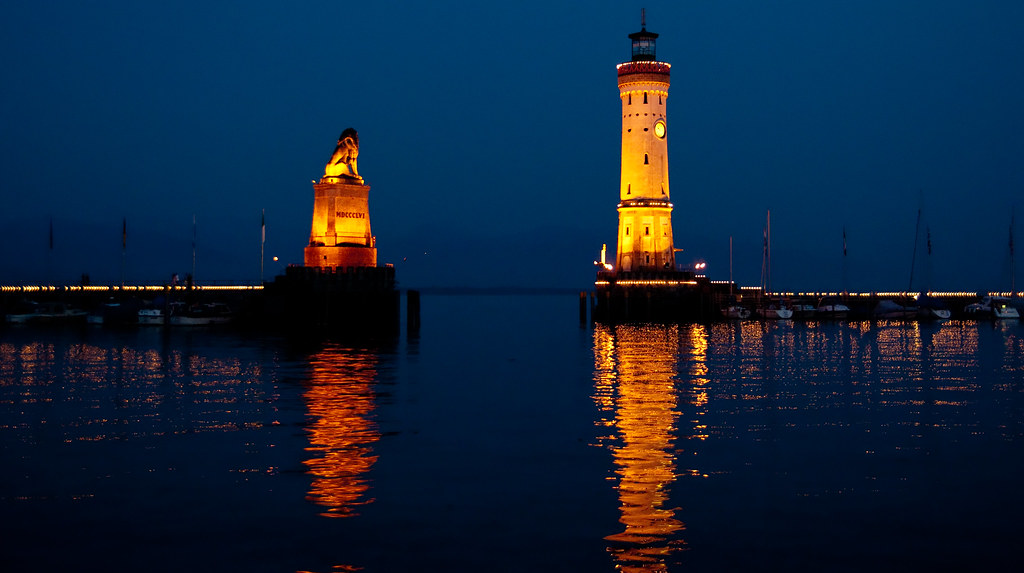
Lake Constance is known as the soul of Europe. On its shores are borders of Germany, Austria and Switzerland. A lighthouse and the Bavarian lion flank the entrance to the port of the German town of Lindau, right in front of Bregenz.
Image by LenDog64
Every June and July Berganz Austria holds a performing arts festival. IIt is known as Berganzer Festspiele or Berganz Festival. The sets are floating on Lake Constance and they are a work of art all in themselves.
So, pretend you are in the audience and a gentle breeze comes off Lake Constance. The twilight hangs in the sky. The lights go up and the most magnificent sets appear.You are amazed and wonder how will this set mix with the production you are about to witness. It transforms you for several hours and the set comes alive and as play concludes you wonder how you will ever think of it any other way.
2011/2012 Andre Chenier
Acrobatic dancers executed a surreal aerial ballet at the top of the giant sculpture.
Performed by the company of Circus & Flying school Airealistic
2009-2010 Aida by Giuseppe Verdi
A time lapse video of the making of the stage
2007/2008: Tosca (Giacomo Puccini).
To add a little more glamor, during some of the performances of the summer of 2008 were filmed scenes of the James Bond film Quantum Of Solace, with Daniel Craig walking among the public.
2005/2006: Il trovatore (Giuseppe Verdi) or
the Trubador
From the original story of a rebellion in the Aragon Court, the action was moved to a modern industrial plant with its fearsome chimneys spitting fire.
Image by Bregenzer Festspiele / Andereart
2003-2004 West Side Story by Leonard Bernstein
La Boheme 2001-2002
An updated the absinthe with Ricard pastis in the Latin Quarter of Paris.
Image by Karl Forster
1999/2000: Un ballo in maschera or A Masked Ball (Giuseppe Verdi).
The image of the grim skeleton watching the tiny figures moving on a book-stage, is definitely one of the most memorable icons of all time from the festival.
Image by Benno Hagleitner
1997/1998: Porgy & Bess (George Gershwin)
A reproduced an apocalyptic scenography Mad Max style. Originally the opera was set in the Afro-American population of the United States. From this play comes the song
Summertime popularized by Ella Fitzgerald and Louis Armstrong, among others.
Image by Karl Forster
1995/96: Fidelio (Beethoven)
It modernized the sole opera composed by Ludwig van Beethoven in a setting that turned the streets of lower class households in overcrowded prison cells.
Image by Karl Forster
Now I am going to jump in time to :
1985-1986: Die Zauberflote by Mozart
2013/2014 Magic Flute Wolfgang Amadeus Mozart
This production just premiered to what I would imagine fantastic reviews.
The History of the Festival:
1946
One year after the end of the Second World War, the first Bregenz Festival was held: the week-long Bregenz Festwoche. The inaugural performance was staged upon two barges moored on Lake Constance – one carrying the stage structures for Mozart’s early work
Bastien et Bastienne, the other the orchestra. In a town that did not even possess a theatre, the idea of mounting a festival seemed eccentric; but the initially makeshift solution of choosing the loveliest part of the town – the lake – as the stage proved to be a hugely successful one. Visitors from Austria, Germany, Switzerland and France made the Festival an international event in its very first year. The Festival orchestra from the outset was the Vienna Symphony Orchestra, which has made a major contribution to the evolution and success of the Festival.
1950
The Bregenz Festival acquired its first home: an off-shore stage erected on wooden piles, on which mainly operettas and ballets were performed. The open-air auditorium had a capacity of 6,500 seats; in the event of rain, a sports’ hall seating 1,000 people could be used instead. The previous year, 1949, had seen the foundation of the Patrons of the Bregenz Festival, a Bregenz residents organization which subsequently became the organizer of the annual Festival.
Stage designer Walter von Hoesslin, with director Adolf Rott, took the first steps towards a distinct Bregenz production style, in that he dispensed with the conventional proscenium stage when designing the Seebühne. For him the lake was not just scenery, but a central element of the productions.
1955
Bregenz’s first theatre, the Kornmarkttheater, opened.
The building was a converted granary, its former function preserved in
the theatre’s name (‘corn market theatre’). With seating for about 700
people, the small theatre was conceived in such a way that opera and
ballet could be performed there. As far as spoken theatre is concerned,
the Kornmarkttheater became the base of the Vorarlberg Regional Theatre
(Vorarlberger Landestheater) and it also hosted the Vienna Burgtheater,
the Volkstheater, the Josefstadt Theater and a number of German theatre
companies giving guest performances during the Festival. In music
theatre, Italian bel canto and light operas were staged here until the
1970s.
1962
Thanks to strong public interest, the Festival became
longer each year and its programme became more varied. Starting in 1962
chamber music concerts and Haydn operas were performed in the
Renaissance Palace at Hohenems. On the Lake, ballet evenings were staged
from 1960 onwards and were a great success.
1972
While two different music theatre productions were mounted simultaneously on the Lake this year (
Der Bettelstudent and
Die Feenkönigin),
Martinsplatz, a square in the old quarter of Bregenz where occasional
serenade concerts had been held in the 1960s, was discovered as a new
venue for Festival events. Since 1972, open-air theatre performances
have been mounted there in cooperation with the Theater für Vorarlberg.
The double bill on the Lake remained a one-off, however: in future only one production would be given on the Lake per year.
1979 und 1980
A long-cherished dream of the Festival
management came true with the opening of the Festival and Congress Hall
in 1980 (and a new Seebühne in 1979). Although, after many discussions,
only part of the original project was realized, it still meant that the
Festival had new possibilities at its disposal. The Festspielhaus (as it
is now known) is connected to the Seebühne, so if the weather suddenly
turns bad, about 1,700 of the 4,500 audience members can be accommodated
there for an indoor performance. The stage has comparable dimensions to
the stages of international opera houses. The new Seebühne has a
concrete core in which the most important facilities and amenities are
located, along with the orchestra pit. The core is surrounded by wooden
piles which support the foundations of the stage set.
1985
A new era for the Festival was ushered in by the triumphant success of
The Magic Flute
on the Lake. From this year on, all productions on the Seebühne run for
two seasons. The stage constructions became sturdier because they now
had to stay put throughout winter too. The Bregenz directors aimed at a
unique production style: namely popular theatre accessible to all and
yet with high artistic standards. The Bregenz style stands for the bold
visual representation of the themes in the operas on the Lake. This
means the operas can be understood on an emotional level and are easier
to comprehend, so that even people who rarely go to the opera can follow
what is happening in the work. It is this production style, the unique
location, and the inimitable atmosphere of open-air theatre which
account for the special appeal of the Bregenz Festival.
1993 und 1994
Public interest in the Seebühne production of
Nabucco
exceeded all expectations; additional viewing stands were erected and
extra performances were scheduled, but still the demand could not be
fully satisfied. Over 300,000 people saw Verdi’s
Nabucco on the
Lake in the summer of '93 and '94. After long discussions, public
subsidy bodies approved construction of a rehearsal stage to be docked
right next to the Festspielhaus. The stage is intended to make
production conditions considerably easier and thus more cost-effective
too.
1995 und 1996
The Bregenz Festival celebrated its fiftieth year. With Beethoven’s
Fidelio on the Lake (conducted by Ulf Schirmer, directed by David Pountney, with sets by Stefanos Lazaridis) and Rimsky-Korsakov’s
The Legend of the Invisible City of Kitezh
(conducted by Vladimir Fedoseyev, directed by Harry Kupfer, with sets
by Hans Schavernoch) the Festival continued its policy of producing a
popular work on the Lake and an unknown work in the Festspielhaus.
In
its jubilee year the Bregenz Festival attracted a record number of
visitors. Again, additional viewing stands were erected and extra
performances scheduled, but the demand for tickets still could not be
fully satisfied. With audiences totalling 318,000
Fidelio became the most visited Seebühne production.
1997 und 1998
The Bregenz Festival departed for new shores.
This was visible not only in the giant highway jutting out of the lake,
scenery for a production of George Gershwin’s Porgy and Bess; the new
departure was also signalled by the opening of the Workshop Theatre
(Werkstattbühne), conceived as an experimental theatre. With the
Workshop Theatre added to the two existing venues, the Seebühne and the
Great Hall of the Festspielhaus, the Festival in 1998 had a total
capacity of 12,000 seats at its disposal. 1998 saw the world premiere of
Georg Friedrich Haas’s opera Nacht (‘Night’) in the Workshop Theatre.
The Bregenz Festival introduced a young people’s programme, cross
culture, which in succeeding years managed to attract up to 10,000 young
visitors annually. Cross culture was awarded the Austrian State Prize
for Public Relations in 1998.
1999 und 2000
Verdi's
A Masked Ball was produced in
1999 on the Lake for the first time in the history of the Bregenz
Festival. The opera, which unites antitheses like Dance and Death, was
staged so spectacularly at Bregenz that pictures of it went round the
world in the summer of 1999. Further highlights were provided by the
operas staged in the Festspielhaus – in 1999, Bohuslav Martinů’s Greek
Passion, in 2000
The Golden Cockerel by Nikolai Rimsky-Korsakov – as well as Workshop Theatre productions such as the mono-opera
Das Tagebuch der Anne Frank (‘The Diary of Anne Frank’) by Grigori Frid, the fringe-festival and in the year 2000 Astor Piazzolla’s ‘
Tango Operita’ Maria de Buenos Aires.
2001 und 2002
Following the great success of Giuseppe Verdi’s A
Masked Ball
on the Lake, the Bregenz Festival engaged the formidable British duo
Richard Jones and Antony McDonald for another production. The opera was
Giacomo Puccini's
La Bohème, which focuses on the lives,
emotions and aspirations of a group of young artists in Paris. The work
staged in the Festspielhaus, Carlisle Floyd’s Of Mice and Men based on
the famous novel by John Steinbeck, is also about dream worlds, the
hopes and disillusionment of two outsiders. In summer 2001 the Bregenz
Festival also mounted contemporary art events: the programme Art Of Our
Times brings contemporary theatre to the Workshop Theatre in a
collaboration with Hamburg’s Thalia Theater, while a new collaboration
with the Kunsthaus Bregenz was concerned with the theme of "America of
the 20th century".
2003
In what was Alfred Wopmann's final season as artistic
director after many years, the Bregenz Festival staged Leonard
Bernstein's hit musical
West Side Story on the world's largest
floating stage. Spectators were captivated by unforgettable songs like
'Maria', 'America' and 'Tonight' coupled with breath-taking dance
sequences. The musical was directed by the American Francesca Zambello,
choreographed by Richard Wherlock, and the stage set designed by George
Tsypin. The Festspielhaus showed Leos Janácek's
The Cunning Little Vixen. As in Mozart's
Magic Flute,
the natural world and its eternal regenerative cycle play an important
part in this popular opera, too. It was directed by Daniel Slater with
sets and costumes by Robert Innes Hopkins. The festival's contemporary
arts programme, KAZ, featured the world premiere of a new opera by Georg
Friedrich Haas,
Die schöne Wunde. At its guest appearance in
summer 2003 the Thalia Theater company of Hamburg presented a premiere
for the first time, an adaptation of Samuel Beckett called
Nacht und Träume.
2004
'Continuity and renewal' was our credo for the era which
began with David Pountney's first season new artistic director.
Bernstein's West Side Story a runaway success returned for a second
season on the Lake. A wind of change was immediately apparent in the
newly designed opening ceremony. "Presenting serious, interesting ideas
in a popular format is what has made the Bregenz Festival such a unique
festival. Continuing on this path and broadening it was and still is my
declared goal," commented artistic director David Pountney about his
first season. Among other innovations was the idea of a showcase, which
was introduced in 2004: Kurt Weill was the featured composer. Two of the
composer's rarely performed, early works for the stage,
The Protagonist and
Royal Palace, were staged together at the Festspielhaus, while the satirical operetta
Der Kuhhandel
was the inaugural production in a new programme of operettas at the
Kornmarkt Theatre; the director was David Pountney. The number of
visitors to events of the contemporary arts programme KAZ (Kunst aus der
Zeit) exceeded all expectations in summer 2004. Expanded and enhanced
by David Pountney, KAZ presented a number of premieres and first
performances, including
The Story of Io by the renowned British
composer Sir Harrison Birtwistle and Hoffmanniana by a young composer
from Vorarlberg, Thomas Dézsy. Hamburg's Thalia Theater had a great
success with guest performances of its satirical comedy about pensioners
Thalia Vista Social Club.
2005
David Pountney's decision to return to epic opera on the
Lake after the musical West Side Story was endorsed by the great
success of the selected production, Giuseppe Verdi's Il trovatore: the
first opera on the Lake under his artistic direction and the most-seen
opera since 1998, surpassing even the hugely popular
A Masked Ball (1999) and
La Bohème (2001).
A total of 172,862 people attended a performance of Giuseppe Verdi's
masterpiece directed by Robert Carsen in the spectacular
refinery-cum-fortress set designed by Paul Steinberg. The Festspielhaus
production and the orchestral concerts reflected the Carl Nielsen
showcase at the festival in summer 2005. The Danish composer's opera
Maskerade
was very well received as the Festspielhaus production, confirming
Pountney's concept of showcasing a single composer throughout the four
weeks of the festival. There was praise not only for the choice of
works, but also for David Pountney's spirited staging of Nielsen's
humorous opera about a masked ball
.
Having got off to such a good start in 2004 with Weill's
Der Kuhhandel, the operetta at the Kornmarkt managed to replicate its success in 2005 with Johann Strauss's forgotten operetta
Der Lustige Krieg.
All performances were completely sold out, showing how enthusiastically
the festival audience welcomed artistic director David Pountney's
original idea of using the Bregenz Kornmarkt Theatre for the rediscovery
of rarely performed operettas.
The contemporary arts programme
KAZ was consolidated and expanded in Pountney's second year, and an
impressive number of tickets were sold - 3,751. This corresponds to 92
percent of capacity in the Kunsthaus Bregenz and 86 percent at the
Workshop Theatre. The KAZ Pass, allowing reductions to all KAZ events,
sold like hot cakes. Because of high demand, twice as many had been
printed in 2004 as in the previous year, and in 2005 the number
available had to be further increased by 40 percent; in July they were
already sold out.
2006
The opera on the Lake in 2005 and 2006, Il trovatore,
took its place as one of the most successful operas produced there in
the past ten years. A total of 301,573 people saw the spectacular
production by Robert Carsen and Paul Steinberg in its two-season run.
Therefore in the popularity stakes, Giuseppe Verdi's masterpiece proved
to be equal to
A Masked Ball (1999/2000) and next behind
La Bohème
(2001/2002). The contemporary programme KAZ and the orchestral concerts
achieved record spectator numbers. In total the Bregenz Festival
attracted 175,819 visitors in 2006.
For festival president Günter
Rhomberg the refurbishment and enlargement of the Festspielhaus,
completed in time for the 2006 festival, was a landmark event. "The most
beautiful present on our 60th anniversary was without doubt the
renovated Festspielhaus. This summer it was at last possible to present
our programme to audiences in an infrastructure that is commensurate
with the quality of the performances. As a result, the Bregenz Festival
can now further consolidate its leading position on the European
festival scene. I would like to take this opportunity to express my
thanks once again to all those who supported us in the financing of the
renovation project and thus made possible such an exceptional festival
season as this last one was," Rhomberg said.
Artistic director
David Pountney was highly satisfied by the record number of people who
attended the events of the contemporary arts programme KAZ and the
orchestral concerts. "In a year when the entire country was celebrating
Mozart, our intention was to give due attention not only to one, but to a
whole range of Austrian artists by showcasing Austrian music in the
orchestral concerts and in Art Of Our Times. And our purpose has been
emphatically endorsed by the festival audience, with new visitor
records. For me personally, though, the highlight of this Austrian
summer, as it were, was Friedrich Cerha’s epic orchestral cycle Spiegel
as the opening concert of the Bregenz Festival. That evening was not
only a tribute to one of the finest living Austrian composers. In
addition to that, the fact that the Bregenz Festival opened with a KAZ
production for the first time was meant to be symbolic of the
significance that the contemporary arts now have in our programming,"
Pountney said.
There was unanimous acclaim among critics and audience members for the Festspielhaus production, The Fall of the House of Usher by Claude Debussy. In what was the first
opera production on the stage of the newly refurbished Festspielhaus,
the recently completed one-act opera The Fall of the House of Usher was
staged in a fascinating triple bill with Debussy's ballets Prélude à
l’après-midi d’un faune and Jeux. In 2006, too, the operetta at the
Kornmarkt was sold out before the first night: 3,053 visitors watched
Jacques Offenbach's lively work Bluebeard in which the fairytale
nobleman is transported by director Stephen Langridge and set designer
George Souglides into a James Bond world and becomes a "serial
monogamist".
2007
The 62nd season of the Bregenz Festival achieved very
positive results: in all, around 200,000 seats were sold for the sixty
scheduled events. The opera on the Lake 2007/08, Giacomo Puccini's opera
thriller
Tosca, was seen by about 164,000 people. The
production is therefore one of the most successful of the past ten
years. As Franz Salzmann, the commercial director of the Bregenz
Festival, commented, "
Tosca has turned out to be an ideal
choice for the Seebühne. Not only the exciting production by Philipp
Himmelmann and the spectacular set design by Johannes Leiacker, but also
the emotional climaxes of this opera have cast a spell over audiences
night after night." The new sound system BOA (Bregenz Open Acoustics)
was widely praised: "For the first time the sound on the Seebühne is
every bit as spectacular as the set," wrote the Münchner Merkur. The
Mannheimer Morgen commented that the Te Deum scene was an "operatic high
mass of supreme power", adding "whoever doesn't get goose-bumps here
doesn't like opera."
In summer 2007 the festival very much bore
the signature of English composer Benjamin Britten, with both his first
and his last work for the stage being performed in addition to several
orchestral pieces. Yoshi Oida’s elegantly austere production of Benjamin
Britten’s late work Death in Venice was hailed by critics. Tenor Alan
Oke was singled out for special praise for his magnificent performance
in the role of the author Gustav von Aschenbach. "I am very happy that
the Britten and Britain showcase went down so well," said artistic
director David Pountney. "England for a long time was seen as the land
without music. And so it's all the more satisfying for me that this
great composer has enthralled festival-goers in Bregenz."
There
was also an enthusiastic reception for the second Britten rarity this
season, the operetta Paul Bunyan staged at the Kornmarkt Theatre. In
particular the playing of the Vorarlberg Symphony Orchestra under the
baton of the Britten specialist Steuart Bedford received positive
reviews. The idea of reintroducing spoken theatre more centrally to the
festival programme with guest performances by the Theater in der
Josefstadt of Vienna (Dangerous Liaisons) and the Thalia Theater of
Hamburg (A Midsummer Night's Dream) was clearly appreciated by
festival-goers.
"Made in Britain" was also the motto of KAZ, the
contemporary programme of the Bregenz Festival. In addition to
performances by the Gob Squad and four concerts which spotlighted
contemporary British composers, two opera were particularly well
received -
The Shops, being given its first performance in Austria, and the football opera
Playing Away, directed by David Pountney.
Seebühne - "9th stadium" of the EURO 2008
The
Tosca Eye coloured orange instead of blue, the Mexican wave sweeping
across the lakeside auditorium, a sea of flags, and peaceful fans - that
was the 2008 European Football Championships in Bregenz. The three-week
festival of football was attended by more than 160,000 supporters in
the auditorium, which had been converted into a public viewing "stadium"
in front of the TV studio on the Seebühne, while the plaza in front of
the Festspielhaus had been made into a yard with goal walls for fans to
practice at. The Baden-Württemberg soccer exhibition was also well
attended. The TV studio, dubbed the "ZDF arena", was used for live
broadcasts hosted by Johannes B. Kerner with expert commentary by Jürgen
Klopp and Urs Meier. "That was grand opera for great sport," as Franz
Salzmann, commercial director of the Bregenz Festival, commented about
the highly successful event.
2008
The opera on the Lake
Tosca
proved to be a great success with audiences in its second season
revival. After being used in the filming of a James Bond movie and in
live TV broadcasts of the football championships, the striking stage
sculpture with the big blue Tosca Eye was able to revert to its original
form as an opera set. The production sold 140,128 seats in 2008, making
Tosca the most-seen revival of the past ten years with 93 percent of capacity sold.
The
music of the Austrian composer Ernst Krenek was showcased in summer
2008, with a number of his works appearing on the festival programme.
The orchestral concerts of the Vienna Symphony Orchestra and the
Vorarlberg Symphony Orchestra revolved around the theme of "Power and
Music" and featured gods, kings and party chairmen. In its second year
at the festival, spoken theatre received some rave reviews: the
highlights were two sold-out theatre productions –
Buddenbrooks
at the Kornmarkt, a dramatisation of the Thomas Mann novel by John von
Düffel staged by Vienna's Theater in der Josefstadt, and René Pollesch's
Die Welt zu Gast bei reichen Eltern in Shed8, a production by
Hamburg's Thalia Theater. Three world premieres were staged at the
Workshop Theatre as part of the contemporary programme KAZ, while the
young people's programme crossculture set new records in the number of
visitors and participants with its most extensive programme of events
since its inception.
James Bond in the Eye of Tosca
Not only audiences at Bregenz were enthusiastic about the spectacular staging of Puccini's opera
Tosca
last summer. In July 2007 a team from EON Productions, the production
company responsible for the James Bond movies, visited one of the last
rehearsals for
Tosca. Producer Barbara Broccoli and director
Marc Forster were impressed – by the unique location on the shore of
Lake Constance, the imposing stage set with its hi-tech capabilities,
and by the modern architecture of the Festspielhaus. In the first week
of May a film crew came to shoot scenes for the new Bond movie
Quantum of Solace and stayed for ten days. In the film Bond discovers his adversary for the first time during a performance of
Tosca
during a seven-and-a-half-minute, high-action sequence shot in the
Festspielhaus and on the Seebühne. Director Marc Forster has
incorporated the opera intriguingly into the action of the film: the
chase through the Festspielhaus is at the end like an apocalyptic silent
film – interspersed with dramatic scenes from the Bregenz
Tosca.
2009
It's one of the most
performed operas in the entire repertoire. A tale of a legendary love
stronger than death, and a very modern parable about nationalism,
belligerence and hatred of the enemy: Giuseppe Verdi's monumental opera
Aida was to receive its first performance on the spectacular Bregenz Floating Stage in the summer of 2009
.
King Roger,
the Festival Opera House production in 2009, brought to the stage a
conflict often explored in the literature and art of the European
modernist period: namely the clash between reason and sensuality. Polish
composer Karol Szymanowski set early Christian asceticism against the
joyous affirmation of life characteristic of late antiquity, evoking the
antagonism very effectively by means of exquisitely rich orchestral
colours and often oriental-sounding melodies.
2010
In summer 2009, director Graham Vick and designer Paul Brown decided to set Verdi's monumental opera
Aida
not in a desert but on and in the water of Lake Constance and their
original interpretation earned them the enthusiastic acclaim of
audiences and critics alike. Aida returned for a second season to the
Floating stage in summer 2010.
A unifying theme of the remainder
of the festival programme was "In Foreign Lands". Central to that was a
retrospective of the forgotten Polish composer Mieczysław Weinberg
(1919-1996), which also included a Weinberg Symposium.
The opera in the Festspielhaus in 2010 was Weinberg's
The Passenger.
The opera is based on a novel with the same title by a Polish Auschwitz
survivor, Zofia Posmysz, and it tells of the chance re-encounter of a
former concentration camp guard (Lisa) with a former inmate (Martha).
Completed in 1968, the opera was not premiered until a concert
performance in 2006. The Passenger is regarded as a work of
extraordinary originality and giant dimensions.
2011
André Chénier, the most famous work by the
Italian composer Umberto Giordano, appealing both as a passionate love
story and a historical thriller, was performed at Bregenz for the first
time on the Seebühne stage in the summer of 2011.
The first in a series of new compositions to be performed at the Festspielhaus was the opera
Achterbahn / Miss Fortune
by the well-established British composer Judith Weir, whose work was
showcased in summer 2011 in a programme section entitled "Creation".
2012
"Grandiose production", "a realm of
operatic magic that can hardly be copied" and "encore, please!"
were just a few of the many accolades that appeared in press coverage of the Bregenz
Festival in its 67th year. The 2012 season of the festival ended
with a total of approx. 147,000 visitors. Of those, 108,338 attended a performance of the opera
on the lake stage, André Chénier.
Courageous and innovative:
in two years, around 230,000 visitors saw the opera André Chénier by the Italian composer Umberto Giordano. No opera
house or festival has ever presented this work to so many visitors in a
comparable span of time. The Bregenz Festival has thus demonstrated that even
less well known operas can draw large audiences.
Under the motto
"Memories of the Future" the 2012 Bregenz Festival not only dazzled
and delighted audiences and critics with André
Chénier, but also impressed with its world premiere staging of the opera Solaris by contemporary composer Detlev
Glanert, whose works also featured prominently in other sections of the
festival programme.
Highlights of the
contemporary arts programme "KAZ" were two concerts at the Kunsthaus
Bregenz and in the Lake Studio of the Festspielhaus as well as a repeat visit
by the Berlin theatre group Nico and the
Navigators. In the drama section, the Vienna Schauspielhaus returned to Bregenz,
giving guest performances of the play Makulatur
by the well-known Austrian child psychiatrist and prose author Paulus
Hochgatterer.
In the crossculture project 2012, Smetana's Die Moldau (Vltava) was crossed with a masterclass of young
composers as well as an open community dance project, Panta rhei – everything flows! The Werkstattbühne production was a
big hit for the amateur dancers and the musicians and was completely sold out.
2013
The
performances on the lake stage were completely sold out and there was not one
cancellation due to rain. The 68th season of the Bregenz Festival was an
exceptional success, with audience figures totalling 259,425. The opera on the
lake stage, The Magic Flute, was virtually sold out shortly after
its premiere on 17 July and attracted in all 202,663 spectators at its 28
performances. This puts the Mozart opera more or less on the same level as Aida
from 2009 as the most often visited opera. Only the musical West Side Story drew
a larger total audience back in 2003.
And
it was not only the opera on the lake stage that met the high expectations in both
artistic and economic respects: another highlight of the festival programme, under
the motto Towards the Light, was the world-premiere staging of
the opera The Merchant of Venice, continuing the Bregenz Festival's
series of mounting productions of never played works at the Festspielhaus. In all, 3,795 people
attended a performance of the opera, which was written by the Polish composer André Tchaikowsky (1935-1982) in
the 1970s and 80s.
Beside
the traditional operas on the lake stage and at the Festspielhaus, the festival
staged the world premiere of The Wasp Factory and the first performance
in Austria of American Lulu, each with two sold-out performances, in addition
to enthusiastically received orchestral concerts and an extensive programme of
events for children and young people.
The
season was an all-round success, as many print media commentators agreed:
"At the Bregenz Festival, David Pountney fills the coffers with Mozart's
Magic Flute, while with André Tchaikowsky's The Merchant of
Venice he gives a further demonstration of his keen instinct for worthwhile
rarities," wrote Opernwelt magazine. Above all it was the
impressive stage set with its technical wizardry and the highly original
production that stayed in the minds of the visitors: "The Bregenz
Festival's Magic Flute musters a fabulous array of materiel. And the
spectacle makes good sense too," the newspaper Frankfurter Rundschau commented.
"Hi-tech stage" was the title of a review in Vorarlberger Nachrichten
and "a child's dream made into opera: the marvellous Magic Flute of
the Bregenz Festival," wrote Süddeutsche Zeitung
Disclaimer: I am not the author of this detail history of the Berganz Festival. I have only copied and pasted. For more information about this wonderful event please just follow the link
http://presse.bregenzerfestspiele.com/en/kategorie/hauptmen/bregenz-festival/history?i=l2
Until We
Meet Again
Claudia